React & TypeScript
Custom Hooks Every Developer Should Know: Reusable React Logic Patterns
Ten fully-typed, copy-paste-ready React custom hooks: useDebounce, useLocalStorage, useFetch, useMediaQuery, useEventListener, useOnClickOutside,...
Published 2026-05-07 by Aditya Mandal.
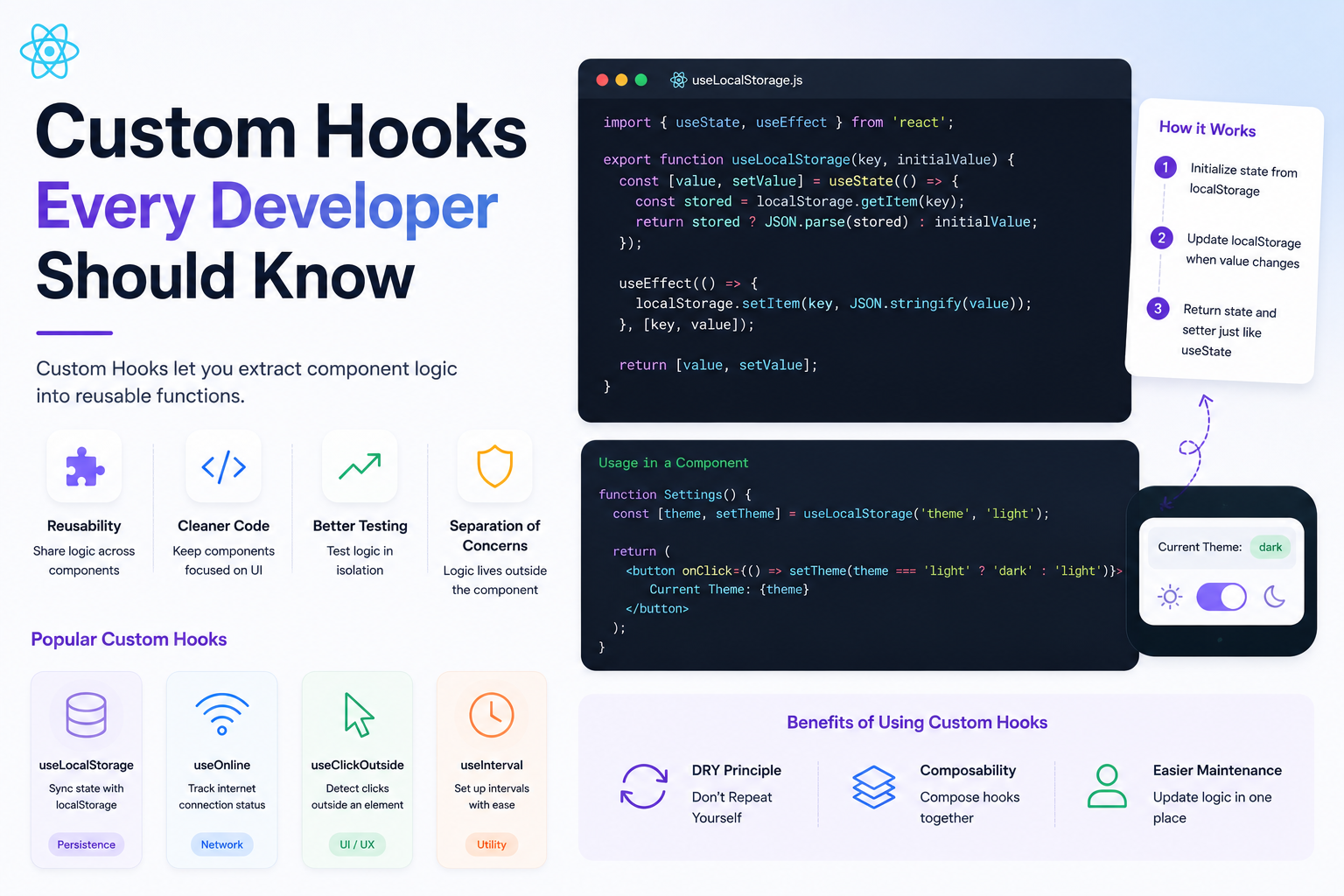
Custom Hooks Every Developer Should Know: Reusable React Logic Patterns Custom hooks are the single most powerful composition primitive React gives you for sharing stateful logic between components. Where higher-order components and render props once forced awkward nesting and brittle wrapper hierarchies, a custom hook is just a function — one that can call other hooks, manage its own state, subscribe to effects, and return exactly the values a component needs. The result is logic that is easy to read, easy to test in isolation, and trivial to reuse across features that share a problem but not a visual design. Once you start extracting behavior into hooks, you stop copy-pasting useEffect blocks and start building a vocabulary of behaviors your whole team can draw from. The hooks in this guide are not clever tricks. They are the load-bearing utilities that show up in almost every real React codebase: debouncing input, persisting state to localStorage, fetching data, responding to viewport changes, listening to DOM events, detecting outside clicks, copying to the clipboard, tracking previous values, measuring the window, and observing element visibility. Each one solves a recurring problem that React's built-in hooks do not address directly. Implementing them once, correctly, with full TypeScript types and proper cleanup, means the rest of your codebase can lean on them without re-deriving the same edge cases every time. A note on scope: every implementation below targets React 18 and React 19 with TypeScript in a 2026 toolchain. They use the function-component-and-hooks model, avoid deprecated patterns (useEffect cleanup is always returned, subscriptions are always torn down), and assume a bundler that understands ESM. Where a hook has an SSR consideration — for example
https://adityamandal.dev/blog/custom-hooks-every-developer-should-know/