Laravel
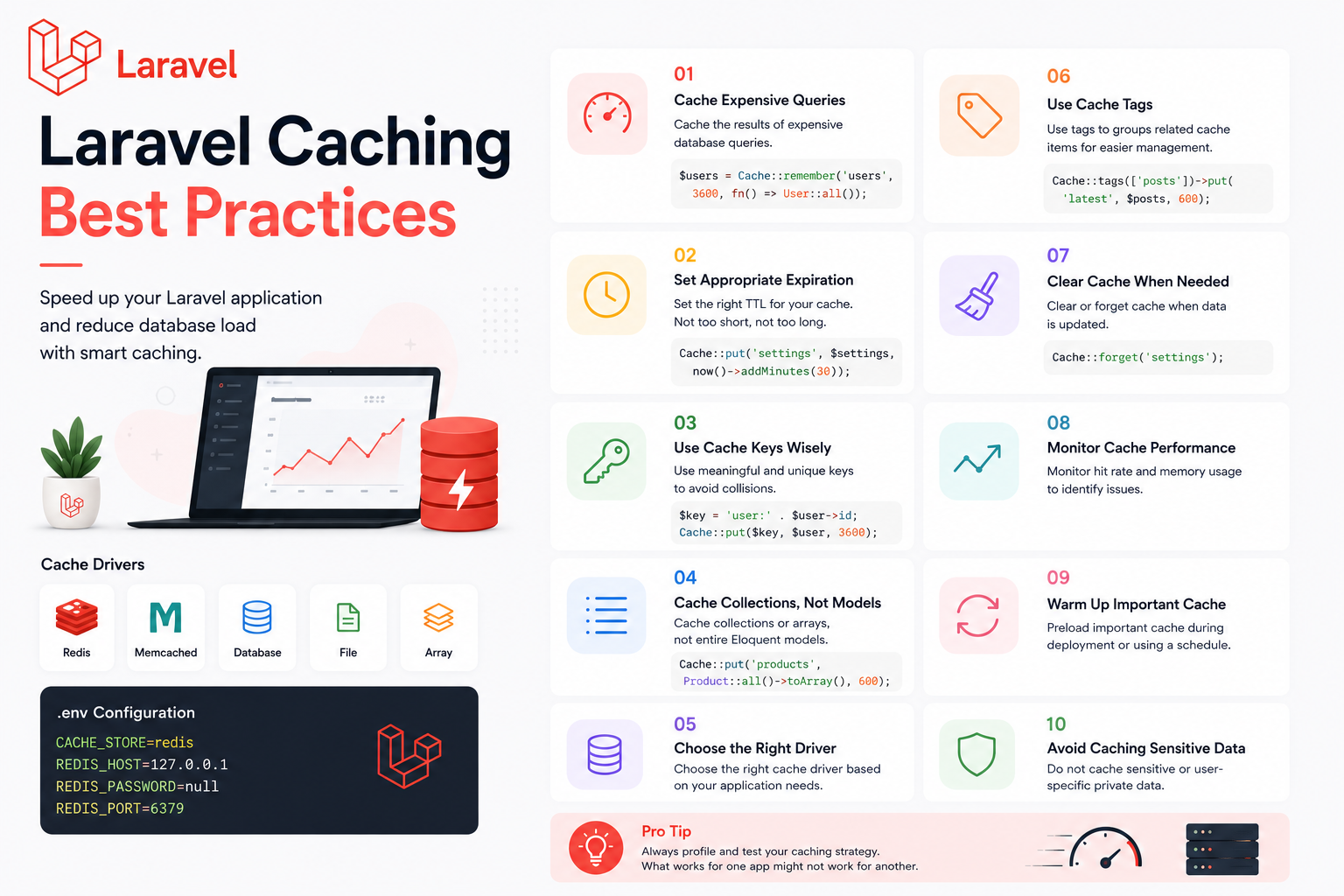
Laravel Caching Best Practices: Speed Up Your App the Right Way
Learn Laravel caching best practices: cache drivers, tags, Eloquent query caching, invalidation strategies, Redis, HTTP cache headers, and a real-world...
Published 2026-04-02 by Aditya Mandal.
Laravel Caching Best Practices: Speed Up Your App the Right Way Every database query, every external API call, and every template render costs your application precious milliseconds. Multiply those milliseconds by your daily request volume and you'll quickly see why caching is one of the highest-leverage optimizations you can make in a Laravel application. A well-placed cache layer can turn a 400ms page load into a 40ms one, reduce database CPU load by an order of magnitude, and let your servers handle traffic spikes that would otherwise buckle them. Caching is not a silver bullet, however—used carelessly it introduces stale data, subtle bugs, and memory pressure that are far harder to debug than the original performance problem. Laravel ships with a clean, unified cache API backed by a dozen different stores—file, Redis, Memcached, DynamoDB, database, and even an in-process array driver for testing. The same Cache::get() call works regardless of where the data lives, which means you can develop against the array driver, run tests against the file driver, and run production on Redis without changing a line of application code. In this article we'll walk through how to configure the cache, perform basic operations, use cache tags, cache Eloquent queries, choose between query-level and response-level caching, invalidate intelligently, leverage Redis-specific features, and wire up HTTP cache headers and CDNs. We'll finish with a real-world product-listing example, a checklist of best practices, common mistakes, and an FAQ. Laravel Cache Drivers and Configuration Laravel's cache configuration lives in config/cache.php, and the active store is controlled by the CACHESTORE environment variable (in Laravel 12 the older CACHEDRIVER name still works as a fallback). Each store is
https://adityamandal.dev/blog/laravel-caching-best-practices/