Laravel
Laravel Repository Pattern Explained: Clean, Testable Data Access
Learn the Laravel repository pattern with practical code: base interfaces, concrete repositories, service provider binding, controller injection, and mock...
Published 2026-02-08 by Aditya Mandal.
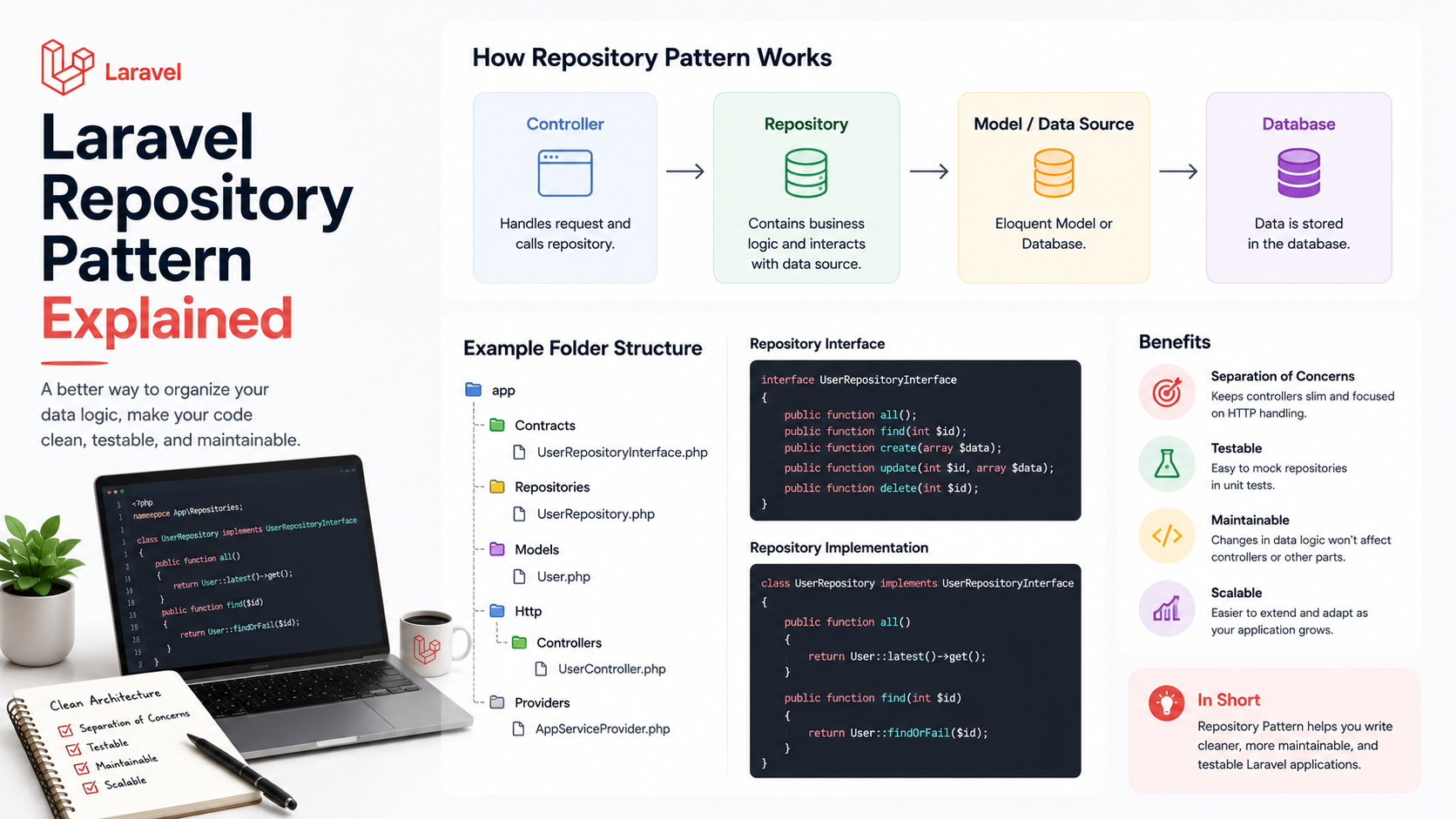
Laravel Repository Pattern Explained: Clean, Testable Data Access The repository pattern is one of the most widely debated architectural patterns in the Laravel community. At its core, it is a way of abstracting your data access layer behind a clean, intention-revealing interface so that the rest of your application — controllers, actions, jobs, listeners — never talks to Eloquent directly. Instead of scattering User::where(...)-get() across a dozen controllers, you call $userRepository-getActiveUsers() and let the repository figure out the query. Your business logic stays readable, your queries stay centralized, and your tests stay fast because you can swap the repository for a mock in one line. Laravel does not force this pattern on you — and that is a feature, not a bug. Eloquent is already a powerful, fluent abstraction over SQL, and for small apps calling the model directly is perfectly fine. But as a Laravel application grows past a handful of controllers, the same query logic tends to get duplicated, changed in one place but not another, and tangled with business rules. The repository pattern gives you a single seam to evolve your data access: change a query once, change caching strategy once, swap Eloquent for an API client once — all without touching the controllers that depend on it. In this article we will build the pattern properly in Laravel 12: a base interface, a generic base repository, concrete implementations, service-provider binding, controller injection, mock-based testing, and a full real-world product catalog repository. We will also be honest about when the pattern is overkill — because wrapping every model in a repository on a weekend project is a classic case of over-engineering, and recognizing that is just as important as knowing how to build
https://adityamandal.dev/blog/laravel-repository-pattern-explained/