React & TypeScript
React Folder Structure in 2026: Patterns That Actually Scale
Learn how to structure a React + TypeScript project that scales: feature-based folders, barrel files, co-located tests, routing structure, and a...
Published 2026-02-17 by Aditya Mandal.
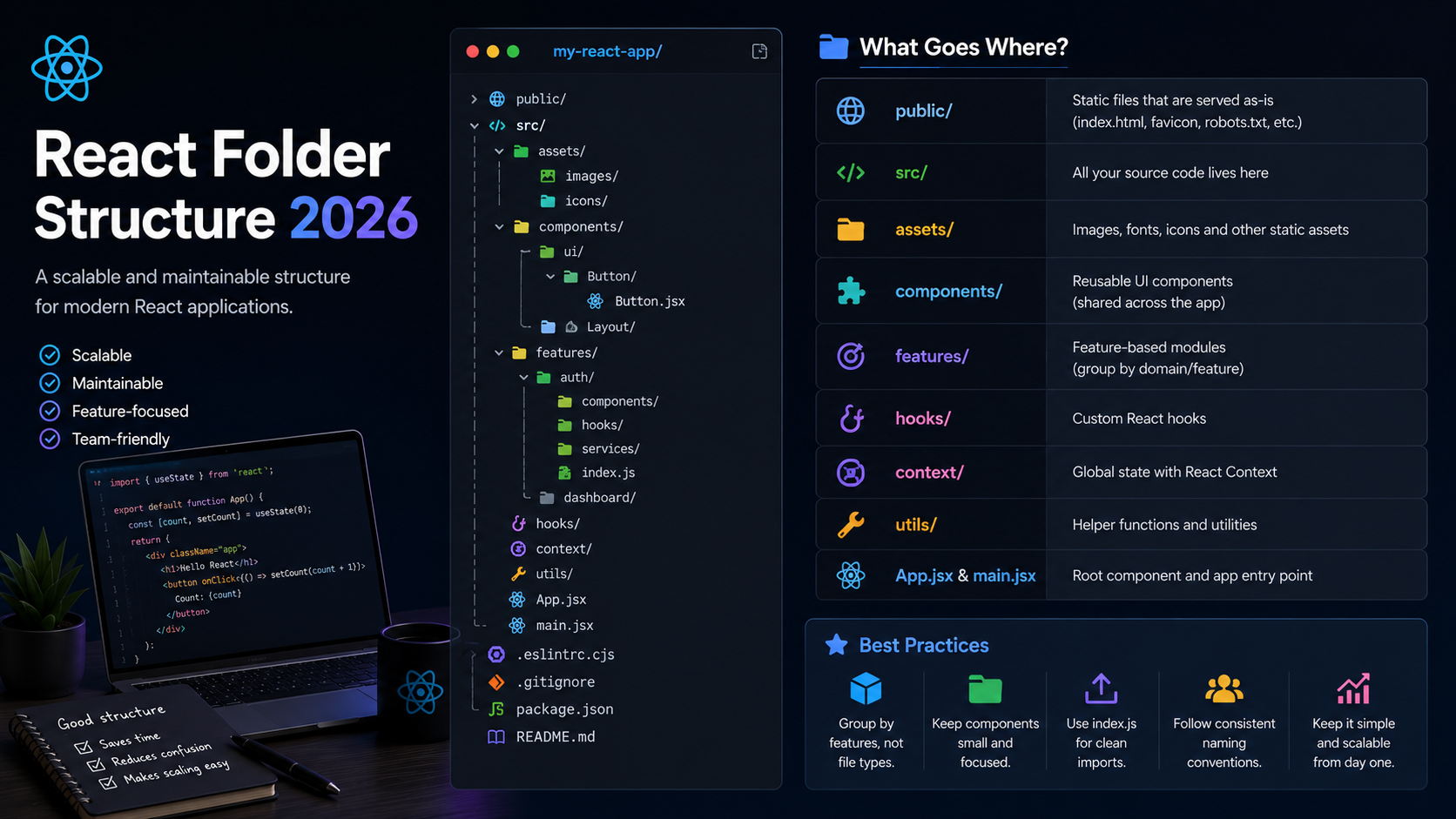
React Folder Structure in 2026: Patterns That Actually Scale Folder structure is one of those topics that every React team argues about and few settle on. The instinct is to treat it as a cosmetic decision — pick a convention, run a linter, move on. But structure is really an architecture decision in disguise. The way you group files determines who imports what, which boundaries are easy to enforce, how much code loads on the first render, and how quickly a new engineer can find the thing they were hired to change. By 2026, with React 19's Server Components, Suspense-based streaming, and mature meta-framework conventions baked into nearly every real codebase, the cost of a bad structure is higher than ever. The evolution has been clear. In 2016 we organized by file type — all components in one folder, all hooks in another. As apps grew, that broke down: a single feature forced you to touch eight directories, and nothing stopped a Button in one screen from reaching into the private state of an unrelated screen. By 2020 the community converged on feature-based organization, and by 2024 tooling caught up. Turbopack, Vite, and Rspack all optimize around how code is chunked, and ESLint's no-restricted-imports and boundaries rules let you enforce structural decisions at commit time instead of in code review. The 2026 answer is not a single canonical tree — it is a small set of patterns that compose: feature folders, explicit public interfaces via barrel files, route-based splitting, and a clear separation between app shell, shared infrastructure, and feature code. What follows is a pragmatic guide. It favors conventions that survive team turnover and codebase growth over conventions that look elegant in a blog post. Every pattern includes copy-paste-ready code, and the final