React & TypeScript
React Performance Optimization: A Practical Guide to Faster Apps
Optimize React performance: understand re-renders, use React.memo, useMemo, useCallback, virtualize lists, code split with React.lazy, use the Profiler, and...
Published 2026-04-15 by Aditya Mandal.
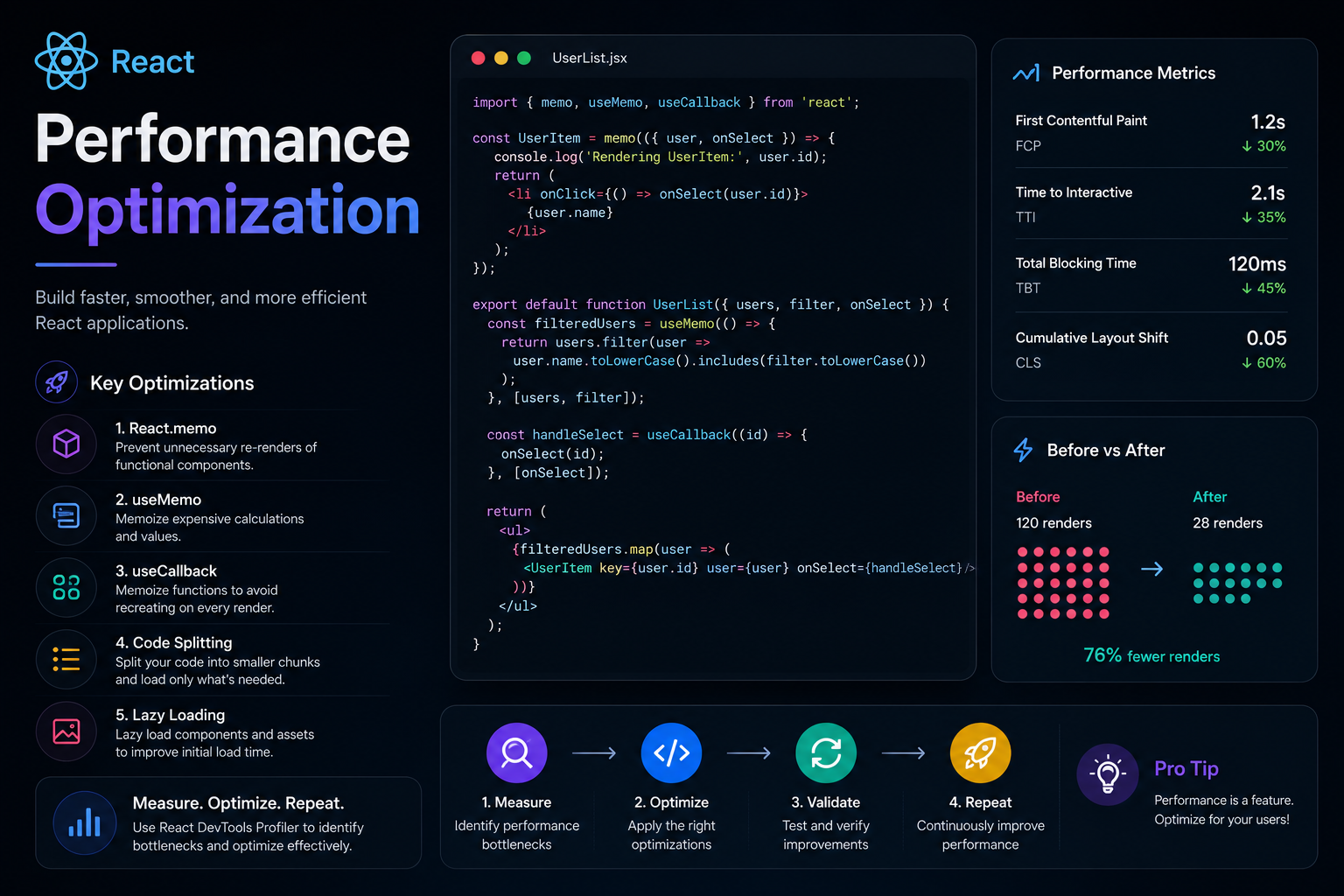
React Performance Optimization: A Practical Guide to Faster Apps React's default rendering model is fast enough for most apps, and that is exactly the problem. "Fast enough" hides compounding waste. A component that re-renders 2 ms of unnecessary work on every keystroke is invisible in a demo and fatal in a dashboard with 40 panels, a 5,000-row table, and a real-time data feed. Performance issues in React rarely come from one slow function; they come from thousands of cheap functions running when they should not. By the time a user notices jank, the rendering graph has grown so tangled that fixing it means re-teaching the team why React re-renders in the first place. The common causes are predictable. Components re-render because their parent did, and props were not memoized. State lives at the top of the tree when it should live near the leaf that owns it. Expensive computations run on every render instead of being memoized. Lists of thousands of DOM nodes are rendered eagerly when a window of 20 would do. Bundle size grows because a 200 KB charting library is imported synchronously onto the login page. None of these are React bugs — they are the natural output of a model where the framework does the cheap thing by default and leaves the expensive decisions to you. This guide is a practical, code-first walkthrough of the optimizations that matter in 2026. Every section includes copy-paste-ready TypeScript, and the final example walks through a real before/after scenario. The goal is not to make every component fast, but to make the right components fast — the ones on the critical path between user input and pixels on screen. Understanding When React Re-Renders Most performance work starts with a misconception: that React re-renders when state "changes." The accurate ru
https://adityamandal.dev/blog/react-performance-optimization/