React & TypeScript
React State Management Comparison: Choosing the Right Tool in 2026
Compare React state management tools: useState, useReducer, Context, Zustand, Jotai, Redux Toolkit, and TanStack Query. Typed code, comparison table,...
Published 2026-06-24 by Aditya Mandal.
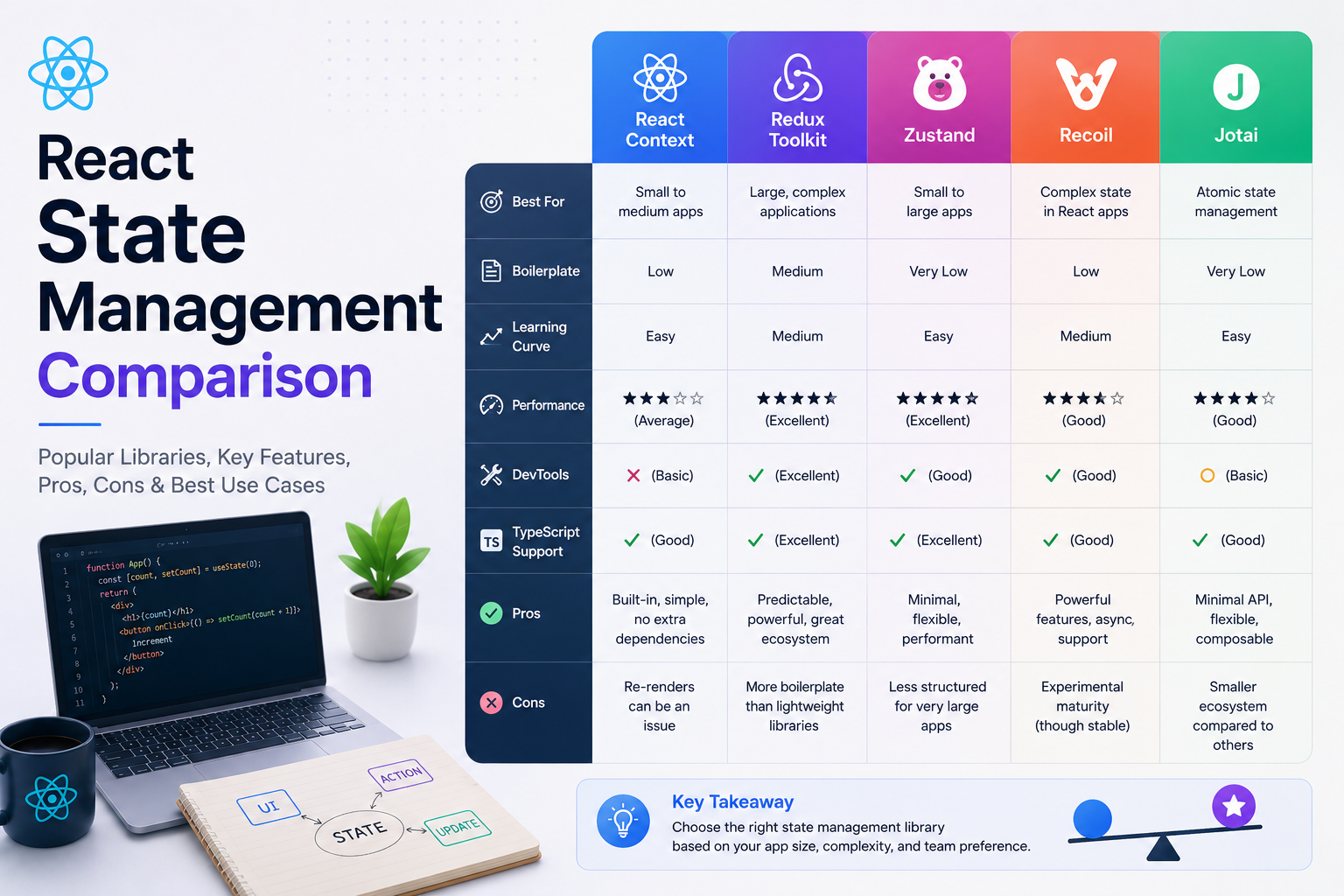
React State Management Comparison: Choosing the Right Tool in 2026 React's state management landscape in 2026 is simultaneously the richest and the most overwhelming it has ever been. The hooks era taught us to colocate state with components, but real applications quickly outgrow useState scattered across a tree. Server components in React 19 blurred the line between client and server state, while the proliferation of atomic stores, signal-inspired libraries, and server-cache tools means that "what state library should I use?" is no longer a single question — it is several questions layered on top of each other. Choosing poorly does not just cost you a few kilobytes; it shapes your component architecture, your re-render profile, your test surface, and how easily new engineers can onboard. The core insight that most teams arrive at eventually is that state is not one thing. There is local UI state (a toggle, a form input, a hover), shared client state (a cart, a theme, an auth session held in memory), and server state (the data that actually lives in your database and arrives via fetch). These have different lifecycles, different owners, and different invalidation rules. A tool that is excellent at one is often mediocre at another. Redux Toolkit is superb for complex, serializable client workflows but is the wrong tool for caching GET /users. TanStack Query is the best-in-class answer for server cache but has no opinion about your client-side form draft. Zustand and Jotai cover the middle ground with very different mental models. This article compares the major options you are likely to reach for in a 2026 React + TypeScript codebase: useState and useReducer, the Context API, Zustand, Jotai, Redux Toolkit, and TanStack Query. For each we will look at what it is good at,
https://adityamandal.dev/blog/react-state-management-comparison/